You thought it was chaos.
The highs that felt like nothing you’d ever experienced. The lows that left you questioning your own sanity. The apologies that felt so genuine you’d have staked your life on them. The warmth that returned, just when you’d decided it was gone forever, in exactly the form you needed it most.
You thought you were in a complicated relationship with a complicated person and that if you could just figure out the right way to love them — the right words, the right amount of space, the right version of yourself — it would finally stabilize into the thing it kept almost becoming.
It wasn’t chaos.
It was a script.
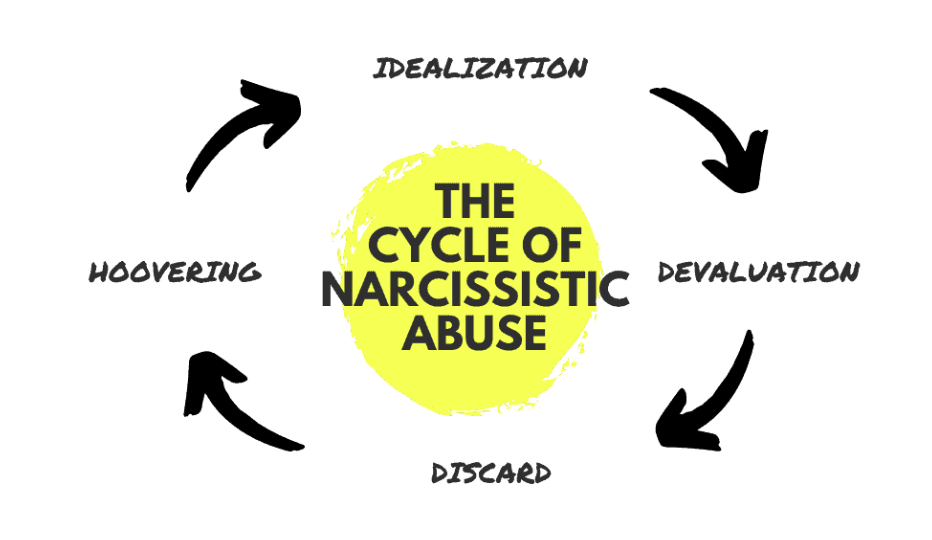
And once you understand the narcissistic abuse cycle stages explained in full — once you can see the architecture underneath what felt like emotional weather — you will never be able to look at what happened to you the same way again.
That is not a small thing.
That is the beginning of actually getting out.
Why Understanding the Narcissistic Abuse Cycle Matters
Before we go stage by stage, let’s be clear about why this matters.
Understanding the narcissistic abuse cycle stages is not about labeling someone. It is not about diagnosing your ex from a distance or reducing a complex human being to a clinical category.
It is about you.
It is about the specific, disorienting, reality-distorting experience of being inside a system you didn’t know was a system. Of trying to make sense of something that was specifically designed to resist being made sense of. Of blaming yourself, adapting yourself, shrinking yourself — in response to a pattern that had nothing to do with your adequacy and everything to do with a cycle that was running long before you arrived.
Research published in the Journal of Personality Disorders consistently shows that survivors of narcissistic abuse report significantly higher rates of complex PTSD, anxiety, and depression than survivors of other types of relationship dysfunction — partly because the abuse is so difficult to identify while it is happening. The cycle is designed to maintain plausible deniability. To keep you explaining, rationalizing, hoping.
Understanding it is how you stop.
The Narcissistic Abuse Cycle Stages Explained: Stage One — Idealization
This is the stage that hooks you.
And it hooks you completely, because it is designed to.
The idealization stage — commonly called love bombing — is the opening act of the narcissistic abuse cycle. It is characterized by an intensity of attention, affection, and apparent connection that feels, to most people who experience it, unlike anything they have ever known.
They pursue you with a focus that feels like being lit up from the inside. They remember everything you say. They mirror your values, your dreams, your sense of humor back to you with startling precision. They tell you — early, urgently, convincingly — that you are different. Special. The person they’ve been waiting for. A connection they’ve never felt before.
The future arrives in this stage, fully formed and intoxicating. Future faking begins here — the house, the family, the life described in vivid detail before the relationship is even weeks old.
It feels like fate.
It feels like finally.
It feels like the love you always suspected existed but had started to doubt was real.
Neurologically, it is. The dopamine flood of early intense romantic attention is real and powerful — Helen Fisher’s landmark fMRI research at Rutgers University showed that early romantic love activates the same reward circuitry as cocaine. You are not naive for responding to this. You are human.
But here is what the idealization stage is actually doing.
It is gathering data.
Every dream you share, every wound you reveal, every value you disclose is being catalogued — consciously or unconsciously — as future material. The idealization is not just about making you feel chosen. It is about learning exactly what you need so that it can be used to keep you later.
The idealization stage ends. It always ends.
And the way it ends — subtly, gradually, then suddenly — is the beginning of stage two.
The Narcissistic Abuse Cycle Stages Explained: Stage Two — Devaluation
This is the stage that breaks people.
Not because it is dramatic — though sometimes it is. But because it is so gradual, so deniable, so easy to explain away that by the time you understand what is happening, you are already deeply inside it.
The devaluation stage is characterized by a slow, systematic withdrawal of the warmth, attention, and validation that defined the idealization stage — replaced by criticism, contempt, emotional withdrawal, and a persistent low-grade message that you are somehow failing to be the person you were during the love bombing phase.
It starts small.
A comment that lands wrong. A tone that wasn’t there before. A moment of coldness after intimacy that you file away as a bad day. An eye roll. A dismissal of something you said that mattered to you. The sense — subtle, deniable, impossible to quite articulate — that the temperature has changed and you are somehow responsible for warming it back up.
And so you try.
You try harder to be who you were at the beginning. You dress differently. You stop mentioning the things that seemed to irritate them. You shrink the parts of yourself that seemed to take up too much space. You become a dedicated, exhausting, full-time student of what version of you is most likely to bring back the person from stage one.
This is where the fawn response takes root and flourishes. Your nervous system learns, quickly and thoroughly, that safety requires appeasement. That love must be earned back, constantly, from a moving target you are never quite hitting.
The devaluation stage also frequently involves gaslighting — the systematic undermining of your perception of reality. The thing you clearly remember being said is rewritten. The incident you know happened is denied. Your emotional responses to genuine mistreatment are reframed as overreactions, insecurities, proof of your instability rather than evidence of theirs.
Over time, you stop trusting your own perception.
Which is exactly the point.
A disoriented partner is a controlled partner. A partner who has been taught to doubt their own reality will stay in almost anything — because they have lost the internal compass that would tell them clearly and confidently: this is not okay, and I deserve better.
The Narcissistic Abuse Cycle Stages Explained: Stage Three — Discard
The discard is the stage that is most visible from the outside and most devastating from the inside.
It is the ending — or what appears to be the ending — of the relationship. And it comes in many forms.
Sometimes it is dramatic and sudden. A relationship that seemed fine yesterday is over today, with a coldness and finality that feels impossible to reconcile with the person who once described your future in such vivid detail.
Sometimes it is a slow fade — a withdrawal so gradual that you spend months trying to hold onto something that has already been decided, reaching for a person who has already emotionally left while still physically present.
Sometimes it is not a complete ending at all. It is a partial discard — a demotion. You are moved from primary partner to backup. Kept at a distance that allows them to maintain the option of return without the inconvenience of actual commitment.
What makes the discard so uniquely devastating — beyond the ordinary grief of a relationship ending — is the specific way it lands for someone who has been through the idealization and devaluation stages.
You are not just losing the person.
You are losing the version of yourself that existed in stage one. The person who felt chosen, seen, special in a way that nothing since has matched. And because the devaluation stage has spent months or years systematically dismantling your self-worth, you arrive at the discard already depleted — already half-convinced that you are the reason this happened.
The discard confirms every terrible thing the devaluation stage taught you to believe about yourself.
Which is why what comes next is so effective.
The Narcissistic Abuse Cycle Stages Explained: Stage Four — Hoovering
The hoover arrives when you have just — just — started to find your footing.
When the fog is beginning to lift. When you are starting to see the relationship with something approaching clarity. When you are, for the first time in a long time, beginning to feel like yourself again.
And then the message arrives.
Casual. Warm. Perfectly calibrated to the specific version of you that existed in stage one — because they gathered that data, remember, and they have not forgotten how to use it.
This is narcissist hoovering — the fourth stage of the narcissistic abuse cycle, and the one that returns you to the beginning.
The hoover is not a genuine reconciliation. It is not growth, reflection, or the arrival of the person they always had the potential to be. It is a supply retrieval mission — the narcissistic ego’s response to running low on the attention, validation, and emotional reaction that you provided, and recognizing that you are still accessible enough to be reactivated.
It works with devastating effectiveness for several reasons.
Your nervous system was conditioned in this relationship. The dopamine system that was trained to associate this specific person with the most intense emotional experiences of your life does not care that those experiences were manufactured. It responds the same way regardless.
The idealization of stage one — the person you fell in love with — is still vivid. And the hoover is designed to evoke exactly that person, with surgical precision, at the exact moment your defenses are lowest.
And underneath everything, the hope that was never fully extinguished — the hope that the person from stage one was real, that the connection meant something, that this time could genuinely be different — flares back to life.
It is not weakness that makes you vulnerable to the hoover.
It is the specific, calculated way the entire cycle was designed to leave you vulnerable to exactly this.
The Narcissistic Abuse Cycle Stages Explained: Why the Cycle Repeats
Here is the part that requires the most compassion — for yourself.
The cycle repeats not because you are stupid, not because you are broken, not because some fundamental flaw in your character keeps delivering you back to the same place.
The cycle repeats because it was designed to repeat.
Each stage feeds the next with precision. The idealization creates an attachment so intense and so neurochemically powerful that the devaluation is survived in hope of its return. The devaluation dismantles your self-trust thoroughly enough that the discard confirms rather than clarifies. The hoover arrives at the exact moment of maximum vulnerability — when you have just enough hope to be reachable and just enough depletion to be unable to resist.
This is not a relationship.
This is a system.
And systems do not change because the people inside them want them to. They change because someone steps outside them entirely.
Research by Dr. Ramani Durvasula — clinical psychologist and one of the foremost authorities on narcissistic abuse — consistently emphasizes that recovery from narcissistic abuse requires understanding the cycle not as a series of isolated incidents but as a unified, self-perpetuating pattern. Seeing the whole is what makes stepping outside it possible.
You are seeing the whole now.
What the Narcissistic Abuse Cycle Does to Your Nervous System
This deserves its own conversation — because the damage of the narcissistic abuse cycle is not just emotional. It is neurological.
Living inside the cycle — the unpredictability, the intermittent reinforcement, the chronic low-grade threat of the devaluation stage — keeps your nervous system in a state of persistent hyperactivation. Your cortisol levels stay elevated. Your threat-detection system stays on high alert. Your body learns to brace.
A 2019 study published in Frontiers in Psychology found that survivors of narcissistic abuse showed measurable changes in their physiological stress response — including elevated baseline cortisol, heightened startle response, and disrupted sleep architecture — consistent with complex trauma rather than ordinary relationship grief.
This is why healing from narcissistic abuse takes longer than healing from ordinary heartbreak. It is not just the heart that needs to recover. It is the nervous system. The body. The threat response that learned, over months or years of the cycle, to treat ordinary relationship experiences as potential danger.
This is also why limerence is so common in the aftermath of narcissistic abuse — the neurochemical intensity of the idealization stage, combined with the intermittent reinforcement of the devaluation and hoover stages, creates a dopamine dependency that can persist long after the relationship ends.
Your obsessive thoughts about them are not proof of love.
They are proof of neurological conditioning.
And conditioning, with the right support, can be recalibrated.
The Signs You Are in the Cycle Right Now
Sometimes the narcissistic abuse cycle stages explained in full are most useful not as a retrospective map but as a present-tense recognition tool.
If you are currently in a relationship and reading this with a growing sense of recognition — here are the signs worth paying attention to:
You feel like you are always trying to get back to the beginning. The relationship was extraordinary once and you have been chasing that version of it ever since. Every good moment feels like proof that it still exists. Every bad moment is explained by something that is about to change.
Your sense of reality is consistently questioned. You find yourself unsure of your own memory. You apologize for reactions that were proportionate to what happened. You have been told, often enough to have started believing it, that you are too sensitive, too demanding, too much.
You feel more anxious than loved. The relationship produces more cortisol than calm. More monitoring than rest. More hypervigilance than safety.
You have left — or tried to leave — multiple times. And each time, something pulled you back. A message. A gesture. A version of them that showed up with such convincing warmth that the reasons you were leaving dissolved before you could hold onto them.
You have lost the thread of who you were before this relationship. Your confidence. Your friendships. Your sense of what you deserve and what is normal. These did not disappear. They were systematically eroded.
If you are recognizing yourself in this list, you are not trapped.
But you may need more support than willpower alone can provide.
How to Actually Break the Cycle
Let’s be honest about what breaking the narcissistic abuse cycle actually requires — because most advice on this topic dramatically underestimates the difficulty.
No contact is not optional. It is the treatment.
Every point of access — every text thread, every social media follow, every mutual friend update — is a potential hoover entry point. And your nervous system, conditioned by the cycle, will respond to even the smallest crumb of contact by reactivating the entire neurochemical loop. No contact is not cruelty. It is the only way to begin starving the cycle of the fuel it needs to continue.
The grief has to be felt — all of it.
Not just the grief for the relationship that ended. The grief for the relationship that never actually existed — the one from stage one that felt so real and was, at least in part, a performance. The grief for the years spent in the cycle. The grief for the version of yourself that existed before it. This grief is enormous and it deserves to be felt properly, with support, rather than bypassed in the urgency to move on.
Trauma-informed therapy is not a luxury — it is a necessity.
EMDR. Somatic experiencing. Attachment-focused therapy with a clinician who understands narcissistic abuse specifically. The damage of the cycle lives in the body, in the nervous system, in the pre-conscious automatic responses that will continue to pull you back toward familiar patterns until they are addressed at the level at which they exist.
Rebuilding self-trust is the long game.
The devaluation stage did specific damage to your relationship with your own perception. Rebuilding it requires small, consistent experiences of trusting your instincts and being proven right. Of setting a boundary and watching it hold. Of noticing a red flag and choosing yourself — even when everything in you wants to explain it away.
This is slow work.
It is the most important work.
You Were Not Weak. You Were Cycled.
Before you finish reading this — I need you to hear something.
The fact that you stayed in the cycle is not evidence of weakness. It is not evidence of poor judgment or low self-worth or some fundamental flaw that made you susceptible to this.
It is evidence that the cycle worked exactly as designed.
On you — a person who loved genuinely, hoped deeply, and brought everything you had to a relationship that was taking inventory of everything you brought and using it to keep you.
The disorganized attachment patterns, the anxious attachment wounds, the nervous system shaped by earlier experiences of love being unpredictable — none of this made you broken. It made you human. And it made you, in specific and painful ways, the ideal target for a cycle that preys on exactly those vulnerabilities.
You were not weak.
You were cycled.
And now you know.
The Cycle Ends When You Do
Not when they change.
Not when the hoover stops coming.
Not when you finally get the apology or the acknowledgment or the closure you deserve and may never receive.
The cycle ends when you decide — with full knowledge of what you are deciding and full compassion for how hard it is — that you are no longer available to be returned to stage one.
That the script has been read.
That you have the playbook now.
And that you are writing a different story.
You Don’t Have to Do This Alone
Breaking the narcissistic abuse cycle is some of the hardest work a human nervous system can do. The pull back is real. The conditioning is deep. The moments of weakness — at midnight, after a hoover, in the particular loneliness of healing from something most people around you don’t fully understand — are real and they are brutal.
Let It Go, the breakup app was built for exactly this.
The tools to interrupt the loop when the hoover hits. The space to process the grief of a relationship that was never what it appeared to be. The support to stay in no contact on the days when no contact feels impossible. The guidance to begin rebuilding the self-trust that the cycle spent so long dismantling.
Because you have read the playbook now.
And you deserve support that matches the size of what you’ve been through.
Download Let It Go — because the cycle ends here, and you don’t have to white-knuckle it alone.
The relationship had a script. You just didn’t have the playbook. Now you do. And that changes everything.







Leave a Reply