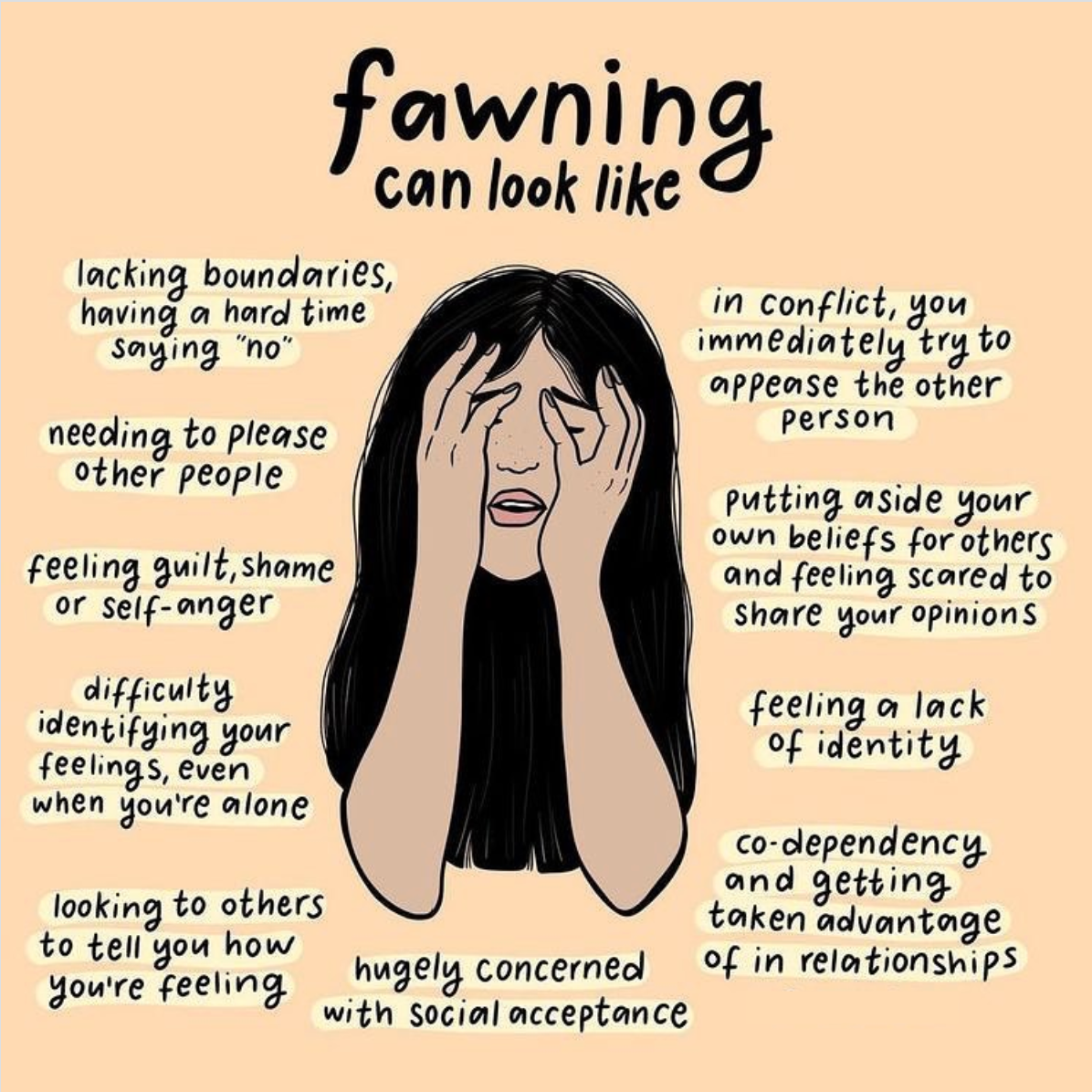
You’re the easy one.
Always so understanding. Never makes a fuss. Always knows how to smooth things over.
What nobody sees is the calculation underneath — the constant reading of the room, the monitoring of their mood, the way you edit yourself in real time to keep the peace.
This is the fawn response toxic relationship pattern. And it is not kindness. It is not love.
It is a trauma response wearing the costume of a personality trait — and it has been running your relationships since long before you knew it had a name.
Here are 7 signs it’s been running yours.
What is the fawn response toxic relationship dynamic?
The constant reading of the room. The monitoring of their mood from the moment you walk in. The instant assessment of which version of them showed up today and what that means for how you need to behave. The way you edit yourself in real time — softening your words, shrinking your needs, abandoning your opinion mid-sentence — because something in you decided, long before this relationship, that keeping the peace was the same as staying safe.
And it is not kindness.
It is not love.
It is a trauma response wearing the costume of a personality trait — and it has been running your relationships since long before you knew it had a name.
You’ve probably heard of fight, flight, and freeze.
The fawn response is the fourth. And it is the one nobody talks about enough.
First named by trauma therapist Pete Walker, the fawn response is what happens when a nervous system learns that the safest way to handle threat is not to fight it, flee it, or freeze in the face of it — but to appease it. To become whatever the threatening person needs you to be. To make yourself so agreeable, so helpful, so unthreatening, so easy — that the danger passes.
It develops, almost always, in childhood.
In homes where a parent’s mood was unpredictable and the consequences of that mood were felt by everyone. Where love was conditional on behavior. Where conflict was dangerous — not just uncomfortable, but genuinely unsafe. Where a child learned that their own needs, feelings, opinions, and existence were secondary to managing the emotional state of the adults around them.
That child became a expert at reading people. At de-escalating. At making themselves small. At anticipating what was needed and providing it before being asked.
That child was praised for it. Called mature. Called helpful. Called so easy to be around.
And that child grew up and brought that survival strategy directly into their adult relationships — especially their romantic ones — where it looks, from the outside, like exceptional emotional intelligence.
From the inside, it feels like slowly disappearing.
Sign #1: You Don’t Know What You Actually Want Anymore
Not because you’re indecisive.
Because you stopped consulting yourself so long ago that you genuinely can’t locate your own preferences anymore.
What do you want for dinner? What movie do you want to watch? What do you actually think about this situation? What do you need right now?
The fawn response in a toxic relationship trains you to bypass these questions entirely. Your wants became irrelevant — or worse, dangerous — early in the relationship. Expressing them led to conflict, sulking, dismissal, or punishment. So you stopped expressing them. And then you stopped feeling them. And then you stopped having them — or so it seemed.
They’re still there. Buried under layers of accommodation and self-erasure, but there.
You know this is you if you feel a low-grade anxiety when someone asks what you want — and your first instinct is to ask what they want first.
Sign #2: You Apologize for Everything. Including Existing.
Sorry for taking up space. Sorry for having a feeling. Sorry for mentioning the thing that hurt you. Sorry for needing something. Sorry for being sick. Sorry for being tired. Sorry for having a reaction to something that warranted a reaction.
The fawn response turns apology into a reflex.
Not because you actually believe you’re wrong — though over time, in a toxic relationship, you start to. But because apologizing de-escalates. It smooths. It returns the environment to something manageable. It is a tool your nervous system reaches for automatically because it has worked before.
In a healthy relationship, apologizing when you’ve genuinely done something wrong is a sign of integrity.
In a fawn response toxic relationship dynamic, apologizing is how you survive.
The difference is everything.
Sign #3: Their Mood Is the Weather and You Are Always Checking the Forecast
You know the second they walk in whether it’s going to be a good day or a bad one.
You know it from the way they close the door. The specific silence of a text that’s taking too long. The tone of a one-word answer. The micro-expression that crosses their face for half a second before they arrange it into something else.
Your nervous system has been tuned, with exquisite precision, to detect their emotional state — and to begin adjusting yours accordingly before they’ve even spoken.
This is not intuition. This is hypervigilance.
It is the radar system your nervous system built when the emotional weather in your environment was unpredictable and the consequences of being caught unprepared were painful. It is exhausting in a way that is hard to explain to people who don’t live with it — a constant, low-level, background hum of monitoring that never fully turns off.
And in a toxic relationship, it never gets to turn off. Because the weather is always changing. Because the threat never fully resolves. Because there is always something to manage, anticipate, prepare for.
You are not sensitive.
You are adaptive.
There is a difference — and understanding it might be the beginning of everything.
Sign #4: You’ve Lost the Thread of Who You Are Outside This Relationship
What did you used to love? What were you interested in before you started filtering everything through whether they would approve of it? Who were you before you became so good at being whoever they needed you to be?
The fawn response in a toxic relationship is an identity thief.
Not dramatic. Gradual. Incremental. You stopped mentioning the thing you were passionate about because they showed mild disinterest once. You stopped seeing the friend they made subtle comments about. You stopped wearing the thing that made you feel like yourself because their reaction made it not worth it. You stopped having opinions in conversations because having opinions led to conflict and conflict led to days of coldness and days of coldness were not survivable.
And one day you looked in the mirror and realized you had no idea who was looking back.
Not because you lost yourself.
Because you gave yourself away. One small accommodation at a time. Over months and years of deciding that keeping the peace was more important than keeping yourself.
Sign #5: Conflict Feels Like a Threat to Your Survival — Not Just an Uncomfortable Conversation
Most people don’t enjoy conflict.
But for someone with a fawn response, conflict isn’t just uncomfortable. It is activating in a way that feels physiologically like danger. Heart rate spikes. Chest tightens. Mind races through every possible way to de-escalate, fix, smooth over, make it stop.
Not because the conflict is actually dangerous.
Because your nervous system was trained in an environment where it was.
And so you will do almost anything to avoid it. Swallow the grievance. Abandon the boundary. Agree with something you don’t agree with. Take responsibility for something that wasn’t yours. Let the thing go — not because it’s been resolved, but because continuing to address it feels more threatening than carrying it silently.
And the things you carry silently accumulate.
Into resentment that has nowhere to go. Into a relationship where your needs are consistently unmet because you never actually expressed them. Into a version of yourself that is so conflict-avoidant you cannot advocate for yourself in any relationship — with partners, with colleagues, with friends, with family.
The fawn response doesn’t stay in the toxic relationship.
It spreads.
Sign #6: You Feel Responsible for Their Emotions. All of Them.
When they’re happy, you feel relief.
When they’re upset — about anything, including things that have nothing to do with you — you feel responsible. You feel the urge to fix it, soothe it, make it better. You feel, somewhere underneath everything, like their emotional state is a reflection of your adequacy as a partner.
This is one of the most insidious aspects of the fawn response toxic relationship dynamic.
Because in the homes where fawning developed, a child’s emotional safety was genuinely dependent on managing the emotional state of the adults around them. So the nervous system learned: their mood is my responsibility. their peace is my job. if they are dysregulated, I have failed.
That belief — carried into adulthood, into intimate relationships — makes you extraordinarily vulnerable to manipulation. Because anyone who consciously or unconsciously understands that you feel responsible for their emotions can use those emotions to control your behavior.
Their anger becomes your correction.
Their disappointment becomes your punishment.
Their happiness becomes the thing you exhaust yourself chasing because it is the only metric you have for whether you are okay.
You are not their emotional caretaker.
You never were.
But your nervous system never got the memo.
Sign #7: You’ve Confused Fawning With Love — And Now You Don’t Know What Love Actually Feels Like
This is the one that sits heaviest.
Because if you have been fawning in relationships for long enough — if self-erasure and accommodation and pleasing have been your primary love language for most of your adult life — you may have genuinely confused the two.
The anxiety of trying to keep someone happy starts to feel like devotion. The relief when they’re pleased with you starts to feel like connection. The constant vigilance starts to feel like caring deeply. The exhaustion starts to feel like proof of how much you love them.
And when someone comes along who is actually safe — who doesn’t require management, who doesn’t punish your needs, who is consistent and present and genuinely interested in what you want — it feels wrong. Flat. Like something is missing.
What’s missing is the anxiety.
And your nervous system has been so calibrated to equate anxiety with love that its absence feels like absence of love itself.
This is the deepest wound of the fawn response toxic relationship pattern.
And it is healable.
But it requires you to first understand that what you’ve been doing is not love.
It is survival.
And you deserve so much more than surviving.
So How Do You Actually Heal This
Let me be honest with you the way I’d be honest with someone I love.
You cannot think your way out of a fawn response.
It lives in your nervous system. In your body. In the automatic, pre-conscious responses that fire before your rational mind has even registered the situation. It was built before language and it will not be dismantled by language alone.
Healing the fawn response requires:
Therapy — specifically trauma-informed therapy. EMDR. Somatic experiencing. Internal Family Systems. Approaches that work with the nervous system directly, not just the narrative. A therapist who understands trauma responses and won’t inadvertently reward your fawning by being pleased when you’re easy and agreeable in session.
Learning to tolerate the discomfort of having needs. This sounds simple. It is not. Every time you express a need, set a boundary, or allow conflict to exist without immediately rushing to resolve it — your nervous system will fire an alarm. The healing is in feeling that alarm and not obeying it. Over and over. Until your body learns that having needs is not dangerous.
Rebuilding your relationship with yourself. What do you like? What do you think? What do you want? These are not trivial questions. They are the questions that will rebuild the self that the fawn response has been systematically dismantling. Answer them. Slowly. Honestly. Even when the answers feel unfamiliar.
Leaving the relationship that requires you to disappear. Because you cannot heal a fawn response while still in the environment that activates it. You cannot learn that your needs are safe while still in a relationship where they are not.
This is the hardest part.
And you don’t have to do it alone.
You Were Built to Survive. Now It’s Time to Live.
The fawn response saved you once.
In a room, in a childhood, in a situation where making yourself small and agreeable and easy was genuinely the safest option available to you — it worked. It protected you. It got you through.
But you are not in that room anymore.
And the strategy that saved you then is costing you everything now — your identity, your needs, your voice, your relationships, your sense of self.
Understanding the fawn response toxic relationship pattern is not about blame. Not about pathologizing yourself. Not about turning your survival instincts into evidence of brokenness.
It is about finally, completely, with compassion and clarity — seeing the pattern for what it is.
So you can choose something different.
So you can stop performing okayness and start actually being okay.
So you can stop making yourself small for people who were never worth that sacrifice.
The Hardest Part Is Leaving
And if you’re still in it — still in the relationship where the fawn response runs your life, still trying to keep the peace with someone who keeps moving the goalposts, still exhausted from the impossible job of managing someone else’s emotional world —
You already know it’s time.
You’ve known for a while.
The part of you that’s reading this, nodding at every sign, feeling seen in a way that is both relieving and terrifying — that part knows.
Letitgo was built for exactly this moment.
Not the tidy version of leaving. The real version — where your nervous system is screaming that it’s not safe to go, where the thought of conflict feels unsurvivable, where you’ve been so thoroughly trained to put their needs first that putting your own first feels genuinely wrong.
The tools. The support. The space to feel what you’ve been suppressing for so long.
Because healing after breakup from a fawn response starts the moment you stop fawning.
And that moment can be right now.
You are not too much. You were just in the wrong place. That ends now.








Leave a Reply