
Reading time: 8 minutes | Category: Relationships, Healing, Mental Health
Most people expect the hardest part of a breakup to be the first few days. What they don’t expect is that weeks or months later, at 2 a.m. when the world is quiet, their ex is still there — in their thoughts, their chest, their body.
If you’re wondering why you can’t seem to move on no matter how hard you try, this article is for you. You’re not stuck because you’re weak. You’re stuck because the brain forms deep attachments — and letting go of them takes more than willpower.
Apps like Letitgo — a breakup recovery and no-contact tracker — exist to support exactly that process. But understanding why this keeps happening is where real healing starts.
The Science Behind Why You Can’t Stop Thinking About Your Ex
Your Brain Treats Breakups Like Withdrawal
When you fall in love, your brain releases a cocktail of chemicals — dopamine, oxytocin, serotonin, and norepinephrine. These are the same reward pathways that fire during addiction. When the relationship ends, your brain doesn’t just feel sad. It goes into chemical withdrawal.
Neuroscientists at Rutgers University found that looking at a photo of a recent ex activates the same brain regions associated with cocaine cravings. Your brain isn’t being dramatic — it’s literally addicted to that person.
This is why the intrusive thoughts feel so compulsive and automatic. You’re not choosing to think about your ex. Your reward system is seeking the hit it’s been cut off from.
The Zeigarnik Effect: Unfinished Business Haunts Us
Psychologist Bluma Zeigarnik discovered that the human mind has a strong tendency to obsess over incomplete tasks. Once something is resolved, the brain files it away. But unfinished business — an unanswered question, a fight that was never resolved, love that didn’t reach a natural conclusion — stays open in our mental browser.
A relationship that ended unexpectedly, without closure, or that left questions unanswered will loop endlessly in your mind because your brain is trying to “finish” what was never finished.
Attachment Styles and Hyperactivation
Your attachment style — formed in childhood — plays a huge role in how intensely you experience post-breakup obsession. People with anxious attachment styles are especially prone to rumination after a breakup. Their nervous systems interpret the loss of a relationship partner as a threat, triggering a hypervigilant search for ways to reconnect or “solve” the separation.
If you find yourself replaying every argument, analyzing every text, or fantasizing about reconciliation, your attachment system may be in overdrive.
Common Reasons You Keep Thinking About Your Ex
1. You Shared an Identity With Them
Long-term relationships become part of how we define ourselves. When the relationship ends, you don’t just lose a person — you lose a version of yourself. Who are you without being “their partner”? This identity vacuum keeps pulling you back toward the familiar.
2. You’re Idealizing the Past
After a breakup, memory becomes selective. You tend to remember the highlights — the laughter, the adventures, the intimacy — while the reasons it ended fade into the background. You’re not missing them, exactly. You’re missing the best version of them, which may never have been the full picture.
3. You’re Avoiding Your Own Emotions
Sometimes obsessive thoughts about an ex are a decoy. Instead of sitting with grief, loneliness, or fear of the future, the mind redirects to “but what are they doing right now?” It feels more actionable to analyze the relationship than to feel the raw pain underneath it.
4. Social Media Is Keeping the Wound Open
Every time you check their profile — even passively — you’re reactivating the neural pathway. You’re essentially giving your brain a micro-dose of the person it’s withdrawing from. This is why going “no contact” or soft-blocking is not petty. It’s neurologically sound advice. Apps like Letitgo are specifically built around this insight — helping you commit to and track a no-contact streak so that accountability becomes part of the healing process.
5. You Haven’t Grieved Yet
Grief is not just for death. Breakups involve the loss of a relationship, a future you imagined, shared routines, and sometimes your social circle. If you jumped straight into distraction mode — work, dating apps, staying busy — the grief never got processed. Unprocessed grief keeps circling back.
How to Stop Thinking About Your Ex: What Actually Works
Allow Yourself to Grieve (For Real This Time)
Set aside deliberate time to feel what you feel — not all day, but intentionally. Journaling, crying, talking to a therapist or trusted friend. When emotions are acknowledged, they tend to move through rather than get stuck.
Interrupt the Loop With Radical Redirection
When you notice the spiral beginning, don’t fight the thought — that gives it more power. Instead, gently redirect to a grounding activity: go for a walk, call a friend, do something that requires your full attention. Cognitive behavioral therapists call this behavioral activation, and it works.
Practice “Closing the Loop”
Since the Zeigarnik Effect thrives on incompleteness, try to create closure for yourself — even without the other person’s participation. Write a letter you’ll never send. Journal about what you learned. Articulate what you wish you’d said. You can give yourself closure. You don’t need them to provide it.
Challenge the Idealized Version
Every time you catch yourself thinking about the best moments, deliberately and gently add the full picture. “We had beautiful moments, and we were also consistently unhappy. Both things are true.” This isn’t about resentment — it’s about accuracy.
Implement a No-Contact Protocol (And Mean It)
No contact is not about being mean or immature. It’s about giving your nervous system a chance to reset. Every check-in, every accidental Instagram scroll, every mutual-friend update resets the withdrawal clock to zero. Give yourself real space — ideally at least 30 to 60 days — to let the neurological bond weaken.
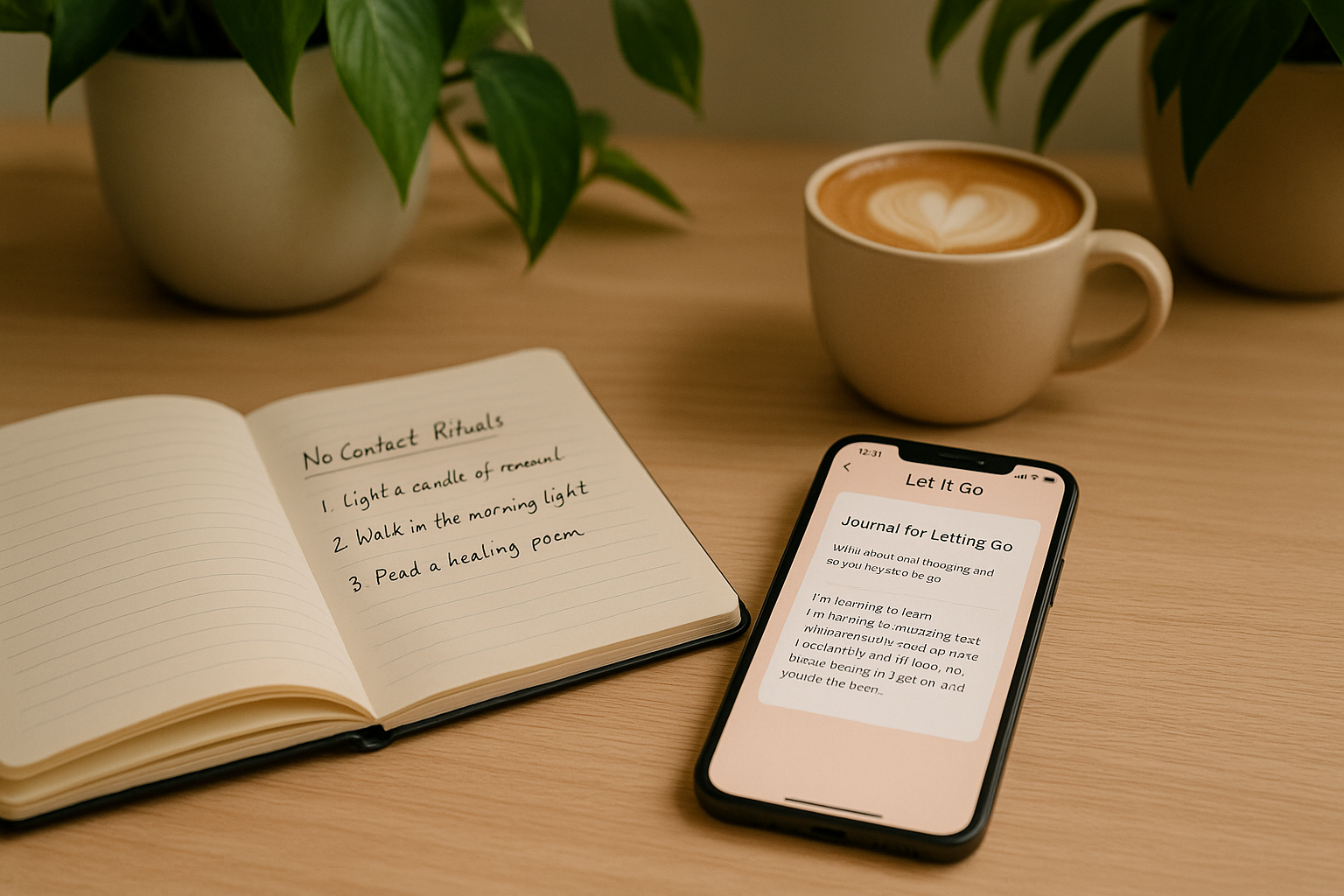
Let It Go is built exactly for this. Letitgo app lets you set a no-contact start date, track your streak day by day, and get reminders and motivation when the urge to reach out peaks. Having a visible streak you don’t want to break is surprisingly powerful — it turns an abstract intention into a concrete, gamified commitment. Think of it as your accountability partner for the hardest part of healing.
Reconnect With Who You Are Outside the Relationship
The antidote to a lost identity is rebuilding one. What did you love before this relationship? What have you been curious about? What do you want your life to look like? Pour energy into rediscovering and creating yourself, not just recovering from them.
Consider Therapy
If intrusive thoughts about an ex are significantly disrupting your daily functioning — affecting sleep, work, relationships, or your sense of self — speaking with a therapist can be genuinely transformative. Techniques like EMDR, ACT (Acceptance and Commitment Therapy), and CBT have strong evidence for helping people process relationship loss and move forward.
When Is It More Than Just Missing Them?
It’s worth distinguishing between the normal grieving process and something that may need more attention. Seek professional support if:
- Thoughts about your ex are consuming several hours of your day, weeks or months after the breakup
- You’re struggling to function at work or maintain other relationships
- You’re engaging in self-destructive behavior (excessive drinking, dangerous decisions) to cope
- You’re experiencing symptoms of depression or anxiety that feel overwhelming
There is no shame in needing help. Heartbreak is one of the most acutely painful human experiences. You deserve support.
The Truth About Letting Go
“Letting go” is one of the most misunderstood concepts in healing. It doesn’t mean you stop caring. It doesn’t mean the relationship didn’t matter. It doesn’t require you to stop loving them at all.
Letting go means releasing your grip on the idea that things should have gone differently. It means making peace with what was and what wasn’t. It means choosing, slowly and imperfectly, to redirect your energy toward your own life.
You won’t wake up one day and suddenly be “over it.” Healing is not linear. But one day, you’ll notice you went a whole morning without thinking about them. Then a day. Then longer.
That’s not forgetting. That’s growing.
Tools That Can Help: Let It Go App
If you’re serious about breaking the cycle, Let It Go is one of the most purposeful tools available for post-breakup healing. It’s a dedicated breakup recovery app and no-contact tracker designed to help you:
- Track your no-contact streak — see exactly how many days you’ve gone without reaching out, and build momentum with each passing day
- Journal your healing — process emotions with guided prompts that help you move through grief instead of around it
- Stay accountable — get check-ins and reminders during the moments when you’re most likely to break no contact (late nights, anniversaries, bad days)
- Measure your progress — see tangible evidence that you’re healing, even when it doesn’t feel that way
Most people try to heal from a breakup using general tools — notes apps, calendars, willpower alone. Let It Go is built specifically for this experience, which makes a meaningful difference. It meets you where you are.
Frequently Asked Questions
How long does it take to stop thinking about an ex? There’s no universal timeline. Research suggests that on average, people begin to feel significantly better between 11 weeks and 3 months after a breakup — but this varies enormously based on relationship length, attachment style, and how much support and intentional healing work someone engages in.
Is it normal to think about an ex years later? Yes. Especially for significant relationships, it’s normal to have occasional thoughts about an ex even years later — particularly during major life transitions or anniversaries. Occasional thoughts are normal; daily obsession that impacts functioning is worth addressing.
Does thinking about your ex mean you’re not over them? Not necessarily. Thoughts are not a measure of readiness to move on. You can have thoughts about an ex and still be moving forward with your life. The goal isn’t to never think about them — it’s to reach a place where those thoughts don’t control you.
Can you ever truly get over someone you really loved? Yes — though “getting over” is the wrong framing. You don’t erase someone who mattered to you. You integrate the experience, learn from it, and carry it forward in a way that makes you wiser and more capable of love, not less.
What is the no-contact rule and does it actually work? The no-contact rule means cutting off all communication with your ex — no texts, no calls, no checking their social media — for a defined period of time, typically 30 to 60 days minimum. It works because it interrupts the neurological addiction loop described above. Every time you check in on your ex, your brain gets a small hit of dopamine that resets the withdrawal process back to zero. No contact gives your nervous system the uninterrupted time it needs to recalibrate. Let It Go is a no-contact tracker app built specifically around this principle — it lets you log your start date, track your streak, and stay accountable on the days when the urge to reach out is strongest.
Why do I still think about my ex even though they treated me badly? This is one of the most disorienting parts of heartbreak — and one of the most common. Trauma bonding, intermittent reinforcement, and the brain’s addiction-like attachment to a relationship can make you miss someone even when the relationship was painful or harmful. The brain doesn’t only bond to people who are good for us. It bonds to people it invested in. Recognizing this pattern is an important first step; it doesn’t mean you want them back, it means your nervous system is doing what nervous systems do.
Is it possible to be friends with an ex right after a breakup? Rarely, and usually not immediately. The research on post-breakup friendships suggests that maintaining close contact too soon after a split tends to slow emotional recovery and increase distress — especially for the person who wanted the relationship to continue. A period of no contact first is almost always healthier. After genuine healing has occurred (not just time passing, but real emotional processing), a friendship may be possible — but only if both people are fully over the romantic attachment.
What does it mean if I dream about my ex? Dreams about an ex are extremely common and don’t necessarily mean anything significant about your current feelings. The brain consolidates memories and emotions during sleep, so people and relationships that had emotional weight tend to resurface in dreams — sometimes for years after a breakup. A dream about your ex is not a sign you should contact them, nor does it mean you’re not healing. It’s simply your brain doing its nightly filing.
How do I stop the urge to text my ex at night? Nighttime is the hardest. Your defenses are down, you’re alone with your thoughts, and the impulse to reach out can feel overwhelming. A few strategies that work: put your phone in another room before bed; text a trusted friend instead when the urge hits; write what you want to say to your ex in a private journal rather than sending it; and use a structured tool like LetItGo, which gives you a streak to protect — a surprisingly effective psychological barrier between the impulse and the action. Seeing “Day 23 of no contact” on your screen before you open your messages can be just enough friction to make you pause.
When should I start dating again after a breakup? There’s no universal right answer, but the most honest one is: when you’re genuinely curious about someone new rather than using dating to fill a void or make your ex jealous. Jumping into dating too soon often leads to “rebound” dynamics that paper over unprocessed grief. A useful benchmark is whether you can go through a day without thinking about your ex more than occasionally. If you’re still in active obsession mode, more healing work — and possibly more time in a structured recovery practice like Let It Go — will serve you better than a new relationship right now.
If you’re ready to start your healing journey, LetItGo is a breakup recovery and no-contact tracker app designed to help you take back control — one day at a time.







Leave a Reply